


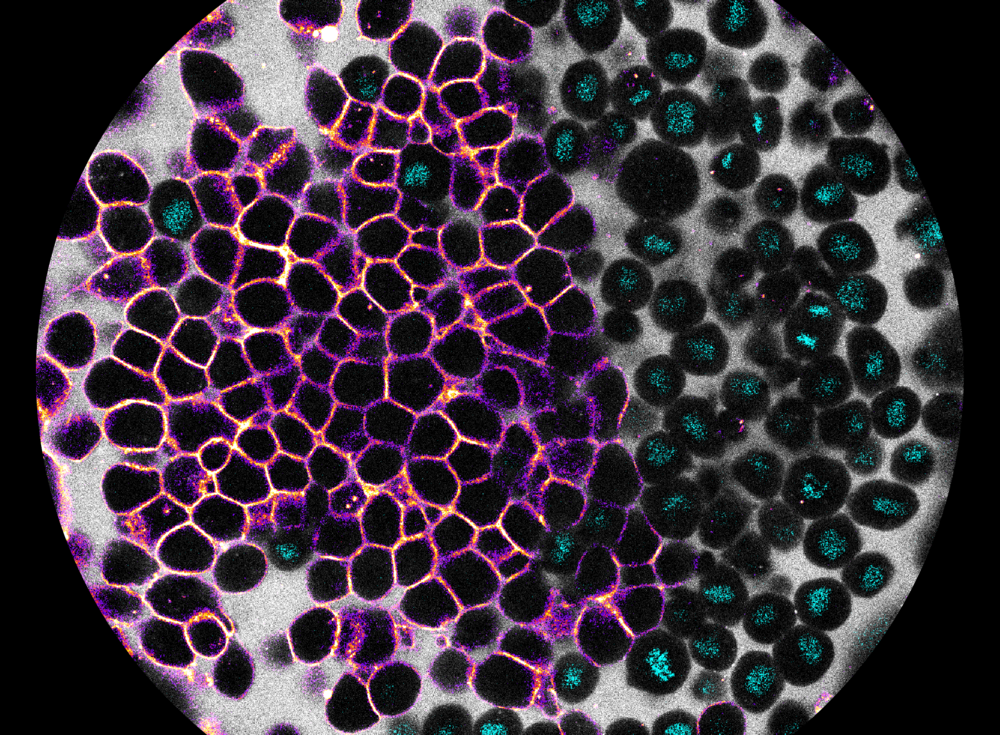
Scientists are now discovering that the physical properties of tissues, such as how stiff or flexible they are, play a crucial role in guiding this process: Abrupt drops of stiffness may allow massive deformations at low energy costs, whereas increasing stiffness may, subsequently, fix those deformations to guide the future geometry. Researchers from University of Graz, Dr. Adrián Aguirre-Tamaral, Dr. Elisa Floris and Prof. Bernat Corominas-Murtra (Department of Biology and field of excellence COLIBRI), in collaboration with researchers from the European Molecular Biology Lab (Heidelberg, GE) and the Crick Institute (London, UK) showed how embryos actively control tissue stiffness during development. Strikingly, the they found that stiffness of the tissue influences how cells communicate with each another and help determining what types of cells they will eventually become in the adult individual —either a cell of an internal organ or a skin cell, for example. This research thereby establishes a fundamental link between the material properties of embryonic tissues and the function that cells will later perform within the adult organism.
To make these discoveries, the international team combined mathematical modelling, advanced live imaging and molecular engineering techniques.
Their findings were reported in two recent studies published in Nature Physics and Nature Cell Biology:
- Nature Physics
Laura Rustarazo-Calvo, Cristina Pallarès-Cartes, Adrián Aguirre-Tamaral, Elisa Floris, Maximilian Hingerl, Camilla Autorino, Arif Ul Maula Khan, Bernat Corominas-Murtra and Nicoletta I. Petridou: Adhesion-driven rigidity transition decoupled from density-driven jamming triggers epithelial organization in embryonic tissues. Nature Physics. Published on 02 Jun 2026. DOI: 10.1038/s41567-026-03276-6
It is worth noting that this paper was selected to be on the cover of the June 2026 issue of Nature Physics, boosting the University of Graz as a referent of interdisciplinary approaches to biological problems.
- Nature Cell Biology
Camilla Autorino, Diana Khoromskaia, Louise Harari, Elisa Floris, Harry Booth, Cristina Pallarès-Cartes, Vesta Petrasiunaite, Michael Dorrity, Bernat Corominas-Murtra, Zena Hadjivasiliou and Nicoletta I. Petridou: Tissue rigidity phase transition shapes morphogen gradients. Nature Cell Biology. Published on 14 May 2026. DOI: 10.1038/s41556-026-01954-4
A research briefing of this article can be found at https://www.nature.com/articles/s41556-026-01987-9
The research was funded by the international FWF/DFG Weave program.