Begin of page section:
Page sections:

  • Go to contents (Accesskey 1)
  • Go to position marker (Accesskey 2)
  • Go to main navigation (Accesskey 3)
  • Go to sub navigation (Accesskey 4)
  • Go to additional information (Accesskey 5)
  • Go to page settings (user/language) (Accesskey 8)
  • Go to search (Accesskey 9)

End of this page section. Go to overview of page sections

Begin of page section:
Page settings:

English en
Deutsch de
Search
Login

End of this page section. Go to overview of page sections

Begin of page section:
Search:

Search for details about Uni Graz
Close

End of this page section. Go to overview of page sections


Search

Begin of page section:
Main navigation:

Page navigation:

  • University

    University
    • About the University
    • Organisation
    • Faculties
    • Library
    • Working at University of Graz
    • Campus
    Developing solutions for the world of tomorrow - that is our mission. Our students and our researchers take on the great challenges of society and carry the knowledge out.
  • Research Profile

    Research Profile
    • Our Expertise
    • Research Questions
    • Research Portal
    • Promoting Research
    • Research Transfer
    • Ethics in Research
    Scientific excellence and the courage to break new ground. Research at the University of Graz creates the foundations for making the future worth living.
  • Studies

    Studies
    • Prospective Students
    • Students
    • Welcome Weeks for First Year Students
  • Community

    Community
    • International
    • Location
    • Research and Business
    • Alumni
    The University of Graz is a hub for international research and brings together scientists and business experts. Moreover, it fosters the exchange and cooperation in study and teaching.
  • Spotlight
Topics
  • Sustainable University
  • Researchers answer
  • Work for us
Close menu

End of this page section. Go to overview of page sections

Begin of page section:
You are here:

University of Graz COLIBRI News Vom Angstfach zum Kinderspiel: wie Gaming-Elemente zum Mathe-Üben motivieren
  • COLIBRI Day 2026
  • Doctoral Consortium Complexity of Life
  • Members
  • Contact
  • News
  • Events

End of this page section. Go to overview of page sections

Wednesday, 05 November 2025

Maths made easy: how gaming elements motivate children to practise

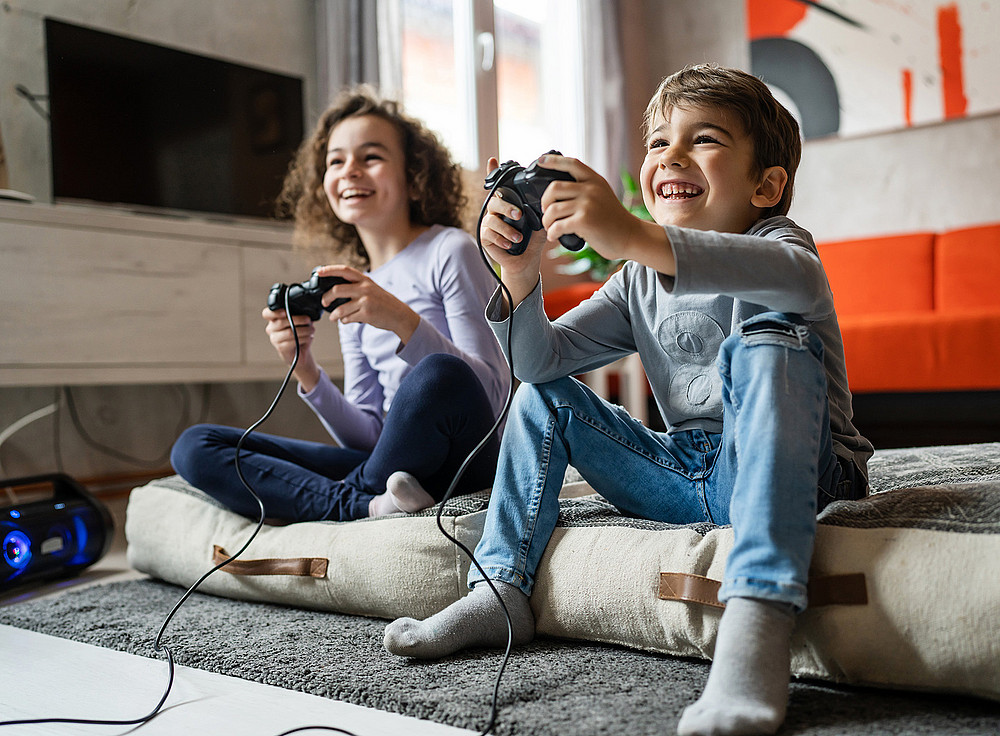
boy and girl playing video game console using controller while sitting at home ©Miljan Zivkovic

Maths problems with video game elements are more fun for children. Psychologist Manuel Ninaus recommends that this finding should be incorporated into the treatment of learning disorders. Photo: Miljan Živković/Adobe Stock

Where does the six belong on a number line from one to ten? This task is a challenge for children with dyscalculia. For fear of failure, many are reluctant to tackle the exercise in the first place. A playful approach can remove this obstacle and give the affected pupils more self-confidence, as psychologist Manuel Ninaus found out in a study.

"Children with learning disorders are often very frustrated and don't believe in their abilities enough. That's why they frequently lack the motivation to practise and learn," explains Manuel Ninaus. In his study, which was published in the journal "Mind, Brain and Education", he investigated the best way to present them with exercises so that they enjoy doing them. The seven to 15-year-old test subjects with diagnosed learning difficulties had to complete estimation tasks on the number line in three versions: mark the correct position on the paper with a pencil, use the computer keyboard to move a white bar accordingly and control a dog to the required position in a video game.

"The test subjects felt most comfortable and competent with the latter version," summarises the psychologist. He concludes that training should be supplemented with playful elements wherever possible. "The design alone gives the children a sense of security and motivates them to continue. This can provide great added value." However, it is essential that developers work together with therapists and brain researchers when designing the exercises. "It must be ensured that the pupils can process the learning content from the video game well and are not overwhelmed by too many sensory impressions," Ninaus explains. Otherwise they would be distracted from the actual question and achieve poorer results.

In Austria, an average of one child per compulsory school class suffers from dyscalculia. The deficit affects the categorisation of numerical quantities and basic arithmetic operations. The disorder is often accompanied by other weaknesses. Therapies and targeted support make it easier to deal with the impairment and protect against secondary illnesses.

Publication:
Manuel Ninaus, Verena Dresen, Stefan E. Huber, Kristian Kiili, Pierpaolo Dondio, Elisabeth M. Weiss, Korbinian Moeller: "Enhancing Situational Mastery Experience and Willingness to Learn with Game Elements in Children with Specific Learning Disorders", Mind, Brain and Education

created by Dagmar Eklaude

Related news

COLIBRI Visiting Fellow Dr. Ziggy O'Reilly

What vision reveals about the seat of consciousness

Researchers at the University of Graz are using vision experiments to investigate how our brain constructs reality. The results offer insights into individual perception, are a piece of the puzzle in the search for the “consciousness” and offer new approaches to understanding neurodiversity.

True crime: psychologist identifies reasons for the fascination of the genre

True crime documentaries, series and podcasts about real crimes have many fans. What is it that makes this genre so fascinating? Is it the insights into the dark side of the human psyche or into meticulous investigations? Or is it that dealing with crime trains our ability to cope with fear? These and other questions are being asked by psychologist Corinna Perchtold-Stefan in a research project. The first results are already available.

Bienendoku

Kurzer Abstract/optional

Begin of page section:
Additional information:

University of Graz
Universitaetsplatz 3
8010 Graz
Austria
  • Contact
  • Web Editors
  • Moodle
  • UNIGRAZonline
  • Imprint
  • Data Protection Declaration
  • Accessibility Declaration
Weatherstation
Uni Graz

End of this page section. Go to overview of page sections

End of this page section. Go to overview of page sections

Begin of page section:

End of this page section. Go to overview of page sections