Begin of page section:
Page sections:

  • Go to contents (Accesskey 1)
  • Go to position marker (Accesskey 2)
  • Go to main navigation (Accesskey 3)
  • Go to sub navigation (Accesskey 4)
  • Go to additional information (Accesskey 5)
  • Go to page settings (user/language) (Accesskey 8)
  • Go to search (Accesskey 9)

End of this page section. Go to overview of page sections

Begin of page section:
Page settings:

English en
Deutsch de
Search
Login

End of this page section. Go to overview of page sections

Begin of page section:
Search:

Search for details about Uni Graz
Close

End of this page section. Go to overview of page sections


Search

Begin of page section:
Main navigation:

Page navigation:

  • University

    University
    • About the University
    • Organisation
    • Faculties
    • Library
    • Working at University of Graz
    • Campus
    Developing solutions for the world of tomorrow - that is our mission. Our students and our researchers take on the great challenges of society and carry the knowledge out.
  • Research Profile

    Research Profile
    • Our Expertise
    • Research Questions
    • Research Portal
    • Promoting Research
    • Research Transfer
    • Ethics in Research
    • Commission for Scientific Integrity
    Scientific excellence and the courage to break new ground. Research at the University of Graz creates the foundations for making the future worth living.
  • Studies

    Studies
    • Prospective Students
    • Students
    • Registration for Study Programme (Winter semester 2026/27)
    • Welcome Weeks for First Year Students
  • Community

    Community
    • International
    • Location
    • Research and Business
    • Alumni
    The University of Graz is a hub for international research and brings together scientists and business experts. Moreover, it fosters the exchange and cooperation in study and teaching.
Topics
  • Sustainable University
  • Researchers answer
  • Work for us
Close menu

End of this page section. Go to overview of page sections

Begin of page section:
You are here:

University of Graz COLIBRI News "Ohne Mathematik gäbe es keine Erklärung der Welt"
  • Complexity of Life Conference 2026
  • Doctoral Forum Complexity of Life
  • Members
  • Contact
  • News
  • Events

End of this page section. Go to overview of page sections

Thursday, 09 July 2026

"Mathematics explains the world"

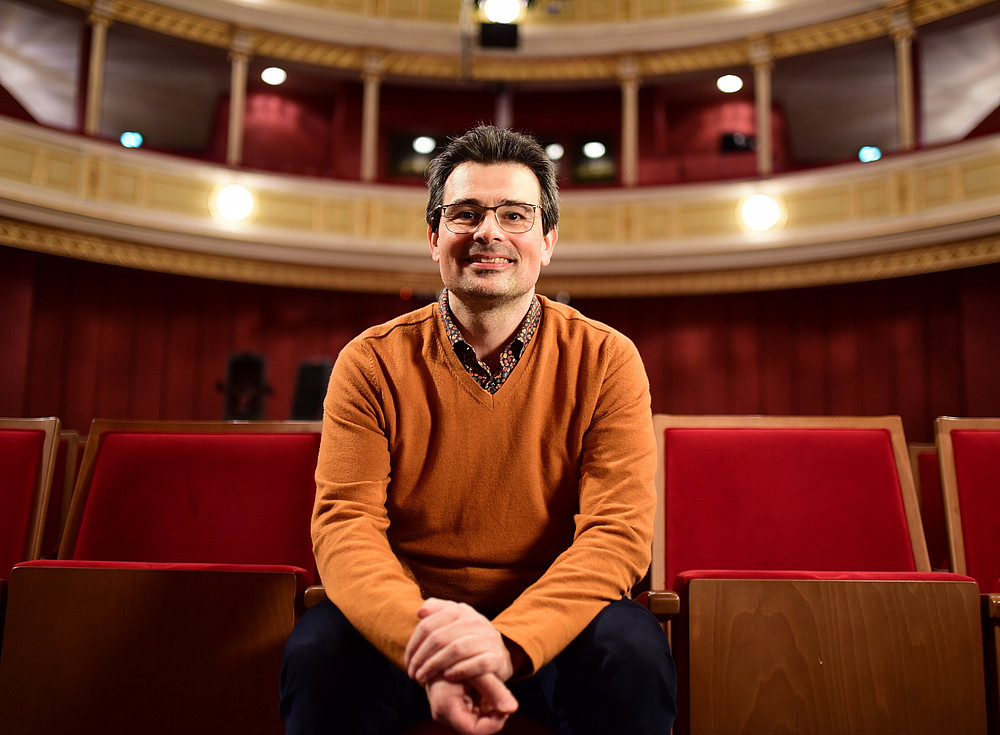
A man wearing an orange jumper and glasses is sitting in a festive hall with red velvet seating. ©Uni Graz/Tzivanopoulos
©Uni Graz/Tzivanopoulos

Klemens Fellner, Dean of the Faculty of Natural Sciences, is a mathematician and musician. Numbers are important in both disciplines. Photo: University of Graz/Tzivanopoulos

How can life be quantified? And what can science reveal that remains hidden from the naked eye? The 14th European Conference on Mathematical and Theoretical Biology at the University of Graz is dedicated to these questions. From 13 to 17 July, around 1,300 researchers from all over the world will gather on campus to discuss models, biological processes and the future of data-driven medicine. Klemens Fellner, Dean of the Faculty of Natural Sciences and Mathematics and a mathematician, talks about the language that explains the world

Mathematics is regarded as an abstract discipline. In fact, however, it touches on very concrete topics: How do infections spread? How do cells develop? How can large amounts of data be analysed in such a way as to yield new insights for diagnostics, treatment or personalised approaches? Behind equations and probabilities lie questions that ultimately affect us all: How does life arise? How does it change? And how much of it can actually be described?

“Mathematics is the tool that quantifies all sciences and makes them verifiable through numbers. Without it, there can be no explanation of the world,” says Klemens Fellner, Dean of the Faculty of Natural Sciences at the University of Graz. If it were a spoken language, would there be communication problems between the disciplines? “Yes, absolutely,” says Fellner. “Not every field of application can be solved using the same models. Physics is different from chemistry. Computed tomography differs from music. As a mathematician, you have to adapt to the respective language – that is, the appropriate equations – and learn them.”

Graz as a mathematics hotspot

This conference highlights the exchange between different scientific approaches. Biologists, medical scientists, mathematicians and computer scientists are increasingly working on the same problems – albeit from different perspectives. Whilst some take samples, collect data or plan experiments, others look for patterns, formulate relationships and calculate possible developments. Such procedures are found in imaging techniques as well as in statistical studies, in drug development, in risk assessments and in epidemiological forecasts. Anyone talking about personalised medicine today is also talking about datasets, probabilities and simulations. Patients remain unique – but it is precisely to better understand this individuality that calculation is needed.

A glance at music shows that mathematical structures play a role not only in laboratories, clinics or computer models. “What we perceive as harmonious has to do with simple numerical ratios between notes: an octave, a fifth or a fourth sound familiar because their vibrations are in specific proportions to one another,” explains Fellner, who is a musician himself. The wave equation, the fundamentals of which were formulated as early as the 18th century, describes how such vibrations propagate – for example, along a string, in a column of air or within a room.

“Perhaps that is why it is so fundamental to the sciences: not because it provides a definitive explanation of the world, but because it constantly asks anew how the world can be described,” says Fellner. “Basic mathematical research often yields applications that only become apparent years later – which makes reliable funding for universities all the more important, as it keeps such long-term avenues of discovery open.” 

Enrol now! 

At the University of Graz, the NAWI Graz “Mathematics” degree programme not only teaches abstract methods and theoretical foundations, but also demonstrates how mathematical thinking helps to precisely describe and solve complex problems in the natural sciences, medicine, technology and society. Enrol now for the Bachelor’s programme by 24 August 2026. 
 

created by Konstantin Tzivanopoulos

Related news

Linking mechanics and function in embryo development

The development of an embryo —the process coming from one cell to a fully developed organism— is one of the most remarkable processes in nature. As an embryo grows, its cells constantly move, organise, and reorganise themselves with extraordinary precision, acquiring both the shape and function that makes the whole organism to work as an integrated system. A crucial question lies on the core of this fascinating process: How the acquisition of function and form are coordinated together?

COLIBRI Visiting Fellow Dr. Ziggy O'Reilly

What vision reveals about the seat of consciousness

Researchers at the University of Graz are using vision experiments to investigate how our brain constructs reality. The results offer insights into individual perception, are a piece of the puzzle in the search for the “consciousness” and offer new approaches to understanding neurodiversity.

True crime: psychologist identifies reasons for the fascination of the genre

True crime documentaries, series and podcasts about real crimes have many fans. What is it that makes this genre so fascinating? Is it the insights into the dark side of the human psyche or into meticulous investigations? Or is it that dealing with crime trains our ability to cope with fear? These and other questions are being asked by psychologist Corinna Perchtold-Stefan in a research project. The first results are already available.

Begin of page section:
Additional information:

University of Graz
Universitaetsplatz 3
8010 Graz
Austria
  • Contact
  • Web Editors
  • Moodle
  • UNIGRAZonline
  • Imprint
  • Data Protection Declaration
  • Accessibility Declaration
Weatherstation
Uni Graz

End of this page section. Go to overview of page sections

End of this page section. Go to overview of page sections

Begin of page section:

End of this page section. Go to overview of page sections