Begin of page section:
Page sections:

  • Go to contents (Accesskey 1)
  • Go to position marker (Accesskey 2)
  • Go to main navigation (Accesskey 3)
  • Go to sub navigation (Accesskey 4)
  • Go to additional information (Accesskey 5)
  • Go to page settings (user/language) (Accesskey 8)
  • Go to search (Accesskey 9)

End of this page section. Go to overview of page sections

Begin of page section:
Page settings:

English en
Deutsch de
Search
Login

End of this page section. Go to overview of page sections

Begin of page section:
Search:

Search for details about Uni Graz
Close

End of this page section. Go to overview of page sections


Search

Begin of page section:
Main navigation:

Page navigation:

  • University

    University
    • About the University
    • Organisation
    • Faculties
    • Library
    • Working at University of Graz
    • Campus
    Developing solutions for the world of tomorrow - that is our mission. Our students and our researchers take on the great challenges of society and carry the knowledge out.
  • Research Profile

    Research Profile
    • Our Expertise
    • Research Questions
    • Research Portal
    • Promoting Research
    • Research Transfer
    • Ethics in Research
    • Commission for Scientific Integrity
    Scientific excellence and the courage to break new ground. Research at the University of Graz creates the foundations for making the future worth living.
  • Studies

    Studies
    • Prospective Students
    • Students
    • Registration for Study Programme (Winter semester 2026/27)
    • Welcome Weeks for First Year Students
  • Community

    Community
    • International
    • Location
    • Research and Business
    • Alumni
    The University of Graz is a hub for international research and brings together scientists and business experts. Moreover, it fosters the exchange and cooperation in study and teaching.
Topics
  • Sustainable University
  • Researchers answer
  • Work for us
Close menu

End of this page section. Go to overview of page sections

Begin of page section:
You are here:

University of Graz COLIBRI News Klebe-Kraft: Forschende zeigen, wie Zellen ihre Funktion bestimmen
  • Complexity of Life Conference 2026
  • Doctoral Forum Complexity of Life
  • Members
  • Contact
  • News
  • Events

End of this page section. Go to overview of page sections

Tuesday, 14 July 2026

Adhesive force: Researchers demonstrate how cells determine their function

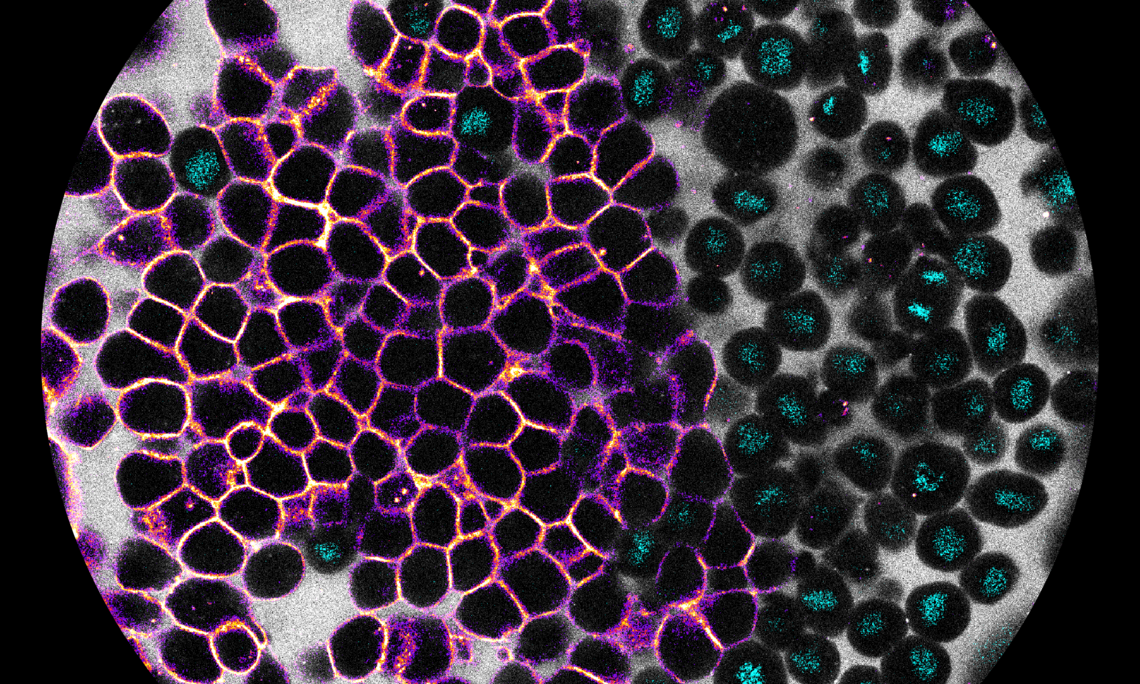
Microscopic image of cell structures showing cell boundaries labelled in magenta and orange, and cell nuclei stained turquoise.

Time-lapse footage of a developing zebrafish embryo as the border cells change their fate. Cell membranes are shown in grey, cell nuclei in yellow and the mesendodermal fate marker Sebox in magenta. Image credit: Camilla Autorino (EMBL Heidelberg).

How does a single cell develop into an organism with skin, muscles, intestines, a heart and other specialised tissues? Two studies published in leading journals have identified a mechanism that links genes, chemical signals and the physical properties of tissues. Scientists from London, Heidelberg and Graz were involved in the research.


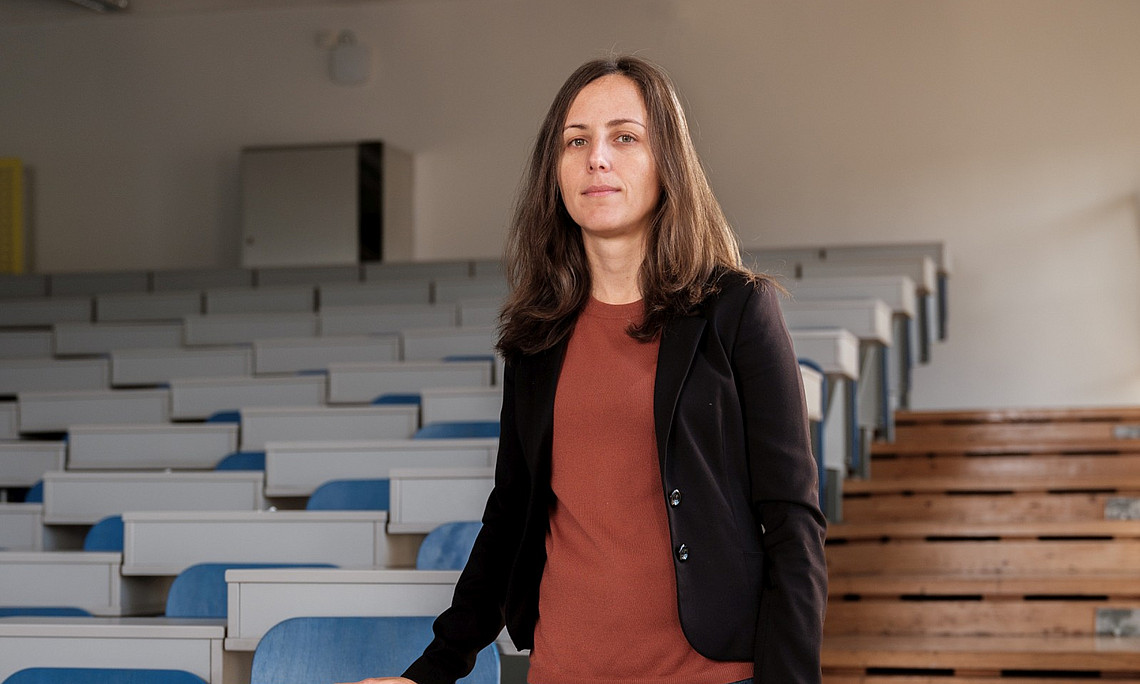
“We wanted to find out why embryonic tissues sometimes behave like a fluid and change shape rapidly during development, but later become firmer and stabilise into new forms. This determines the role the cell will later take on – for example, whether it becomes a liver cell or a skin cell,” explains Bernat Corominas Murtra from the Institute of Biology at the University of Graz. A key factor in this process is what is known as ‘adhesion’ – the force with which cells stick to one another. 

If this cell adhesion exceeds a critical point, the tissue changes abruptly. It becomes stiffer, and the fine gaps close. This sets the course for the tissue’s further development. This process was particularly evident in the zebrafish embryos studied, as they are transparent in their early stages. Researchers can therefore observe, within the living embryo, how tissue building blocks move, adhere to one another and respond to developmental signals. 

Coromina Murtra explains the role of mathematical biology in the studies: “Mathematics makes the causal chain visible. This enabled us to show how a change at the cellular level – namely the ‘adhesion effect’ – creates an abrupt transition at the tissue level and thereby influences how far a developmental signal reaches within the embryo.” His research is driven by curiosity and the joy of finding answers to the question of how complex life arises. “In doing so, we take a radically interdisciplinary approach, breaking down the boundaries between disciplines in order to seek answers from as unbiased a perspective as possible,” explains the researcher. 

Graz as a hub for mathematical biology

Mathematics will soon take centre stage at a major event in Graz: from 13 to 17 July 2026, the “ECMTB 2026” congress will bring more than 1,000 researchers from the fields of mathematical and theoretical biology to the University of Graz. The conference will demonstrate how mathematics makes biological processes quantifiable. Topics will range from cell movement and embryonic development, through infection dynamics, to data-driven methods in medicine and the life sciences.


Publications:

Laura Rustarazo Calvo, Cristina Pallarès Cartes, Adrián Aguirre Tamaral et al.: “Adhesion-driven rigidity transition decoupled from density-driven jamming triggers epithelial organisation in embryonic tissues”. Cover story in *Nature Physics*, published on 2 June 2026, DOI: 10.1038/s41567-026-03276-6.

Camilla Autorino et al.: “Tissue rigidity phase transition shapes morphogen gradients”. Nature Cell Biology, published on 14 May 2026, DOI: 10.1038/s41556-026-01954-4.


>> Anyone wishing to specialise in mathematics and/or biology can do so by studying at the University of Graz: https://www.uni-graz.at/de/studium/ 
created by Gerhild Leljak

Related news

Linking mechanics and function in embryo development

The development of an embryo —the process coming from one cell to a fully developed organism— is one of the most remarkable processes in nature. As an embryo grows, its cells constantly move, organise, and reorganise themselves with extraordinary precision, acquiring both the shape and function that makes the whole organism to work as an integrated system. A crucial question lies on the core of this fascinating process: How the acquisition of function and form are coordinated together?

COLIBRI Visiting Fellow Dr. Ziggy O'Reilly

What vision reveals about the seat of consciousness

Researchers at the University of Graz are using vision experiments to investigate how our brain constructs reality. The results offer insights into individual perception, are a piece of the puzzle in the search for the “consciousness” and offer new approaches to understanding neurodiversity.

True crime: psychologist identifies reasons for the fascination of the genre

True crime documentaries, series and podcasts about real crimes have many fans. What is it that makes this genre so fascinating? Is it the insights into the dark side of the human psyche or into meticulous investigations? Or is it that dealing with crime trains our ability to cope with fear? These and other questions are being asked by psychologist Corinna Perchtold-Stefan in a research project. The first results are already available.

Begin of page section:
Additional information:

University of Graz
Universitaetsplatz 3
8010 Graz
Austria
  • Contact
  • Web Editors
  • Moodle
  • UNIGRAZonline
  • Imprint
  • Data Protection Declaration
  • Accessibility Declaration
Weatherstation
Uni Graz

End of this page section. Go to overview of page sections

End of this page section. Go to overview of page sections

Begin of page section:

End of this page section. Go to overview of page sections