Begin of page section:
Page sections:

  • Go to contents (Accesskey 1)
  • Go to position marker (Accesskey 2)
  • Go to main navigation (Accesskey 3)
  • Go to sub navigation (Accesskey 4)
  • Go to additional information (Accesskey 5)
  • Go to page settings (user/language) (Accesskey 8)
  • Go to search (Accesskey 9)

End of this page section. Go to overview of page sections

Begin of page section:
Page settings:

English en
Deutsch de
Search
Login

End of this page section. Go to overview of page sections

Begin of page section:
Search:

Search for details about Uni Graz
Close

End of this page section. Go to overview of page sections


Search

Begin of page section:
Main navigation:

Page navigation:

  • University

    University
    • About the University
    • Organisation
    • Faculties
    • Library
    • Working at University of Graz
    • Campus
    Developing solutions for the world of tomorrow - that is our mission. Our students and our researchers take on the great challenges of society and carry the knowledge out.
  • Research Profile

    Research Profile
    • Our Expertise
    • Research Questions
    • Research Portal
    • Promoting Research
    • Research Transfer
    • Ethics in Research
    Scientific excellence and the courage to break new ground. Research at the University of Graz creates the foundations for making the future worth living.
  • Studies

    Studies
    • Prospective Students
    • Students
    • Welcome Weeks for First Year Students
  • Community

    Community
    • International
    • Location
    • Research and Business
    • Alumni
    The University of Graz is a hub for international research and brings together scientists and business experts. Moreover, it fosters the exchange and cooperation in study and teaching.
  • Spotlight
Topics
  • Sustainable University
  • Researchers answer
  • Work for us
Close menu

End of this page section. Go to overview of page sections

Begin of page section:
You are here:

University of Graz COLIBRI News What vision reveals about the seat of consciousness
  • COLIBRI Day 2026
  • Doctoral Consortium Complexity of Life
  • Members
  • Contact
  • News
  • Events

End of this page section. Go to overview of page sections

Wednesday, 07 May 2025

What vision reveals about the seat of consciousness

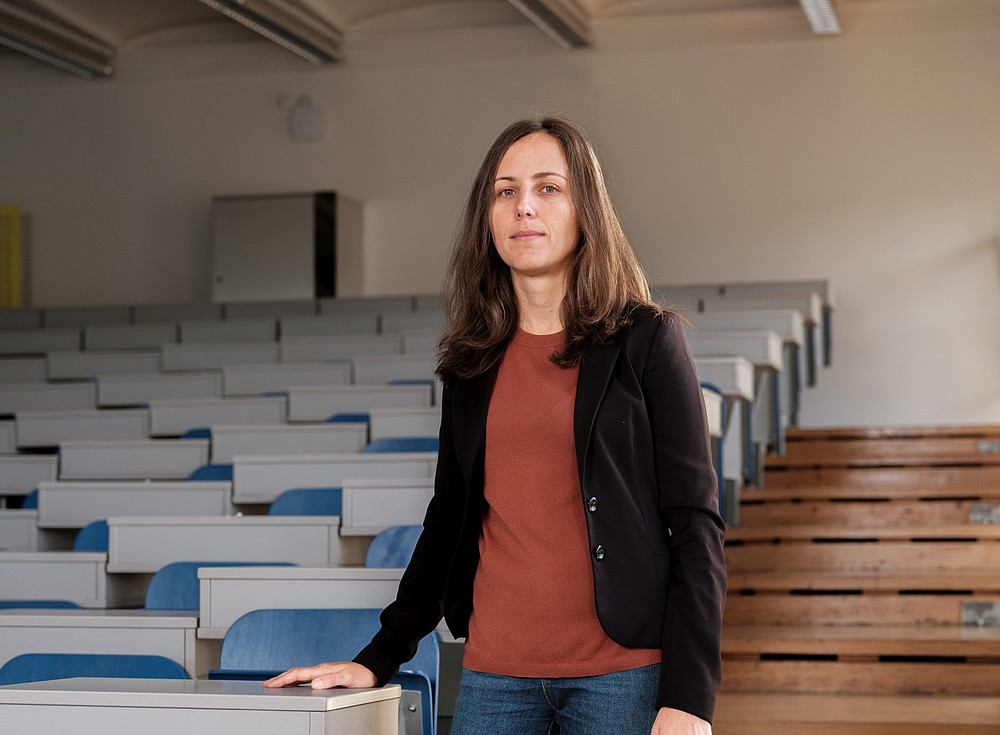
Photograph of a female professor standing in the middle of an empty university classroom, with blue and white seats. The shot is frontal, and the professor is wearing jeans, a black blazer, brown shoes, and an orange top. ©Manuel Schaffernak

Natalia Zaretskaya and her team are searching for the seat of consciousness in the brain. Photo: University of Graz/Schaffernak

Researchers at the University of Graz are using vision experiments to investigate how our brain constructs reality. The results offer insights into individual perception, are a piece of the puzzle in the search for the “consciousness” and offer new approaches to understanding neurodiversity.

Ever seen a hole in your own hand? It may sound crazy, but it’s the result of a little experiment that anyone can do themselves. You take a roll of paper, hold it in front of one eye and focus with both eyes on the palm of your hand. Suddenly you see a hole. The phenomenon behind it is called “binocular rivalry.”

“Our eyes always see two slightly different images, which the brain puts together like a puzzle to form a single 3D image,“ says Natalia Zaretskaya, head of the “Visual Neuroscience” research team at the University of Graz. The psychologist and her team are not only investigating how we see, but also where exactly in the brain consciousness – that is, the “I” – sits.

Different Pictures

“A hot candidate for this is the area in which the brain independently creates something new from two different inputs,” explains the researcher. To investigate this, her team uses binocular rivalry and 3D glasses, as seen in cinemas. Polarized lenses allow two images that are so different that the brain cannot combine them to be shown to the eyes – for example, left-tilted diagonal lines for one eye and right-tilted for the other.

“The test subjects experience an alternation between the images, a transition,” explains Cemre Yilmaz, doctoral student in the lab and the first author of this research. This effect has been known for a long time, but it has received little attention in research. “Only the duration of the transitions has been studied,” says Yilmaz. However, the researchers were looking for something different. “We asked our test subjects: How do you perceive these changes?“ The result surprised even the experienced neuroscientist: “We were able to identify 20 different ways in which people perceive these image changes.“ Sometimes the images overlap, sometimes parts suddenly appear and disappear again, or they transform from one side to the other in wave-like movements. 

Individual Signatures

41 people took part in the experiments, which were repeated at intervals of several weeks. One thing was clear, explains the researcher: “Every person perceives transitions differently”. And the test subjects always experienced the same type of transitions, regardless of the test period. “So, there are personal signatures of perception,” concludes Zaretskaya. This discovery could be the key to understanding where our consciousness is located in the brain. “For the research world, this means that we need to put much more effort into the study of this phenomenon.”

In addition to our understanding of consciousness, the results also help us to better understand neurodiverse people – for example, those with ADHD or autism. “These individuals often take longer to perceive the image changes,” explains Zaretskaya. „Our research now provides a basis for further investigation. If certain transitions are more frequent in people with ADHD or autism, it may be possible to develop more accurate diagnostic methods. But we are only at the beginning of this journey,” explains Zaretskaya. Next, the researchers want to repeat the test while simultaneously measuring the brain waves using EEG. “We want to find out whether the different perceptions can also be seen there,” the neuroscientist concludes.

Publication

The complexity of human subjective experience during binocular rivalry; Cemre Yilmaz , Laura Pabel , Elias Kerschenbauer , Anja Ischebeck , Alexandra Sipatchin , Andreas Bartels , Natalia Zaretskaya;; Neuroscience of Consciousness, Volume 2025, Issue 1, 2025, niaf004, https://doi.org/10.1093/nc/niaf004

created by Roman Vilgut

Related news

COLIBRI Visiting Fellow Dr. Ziggy O'Reilly

True crime: psychologist identifies reasons for the fascination of the genre

True crime documentaries, series and podcasts about real crimes have many fans. What is it that makes this genre so fascinating? Is it the insights into the dark side of the human psyche or into meticulous investigations? Or is it that dealing with crime trains our ability to cope with fear? These and other questions are being asked by psychologist Corinna Perchtold-Stefan in a research project. The first results are already available.

Bienendoku

Kurzer Abstract/optional

Bees under observation: University of Graz provides unprecedented insights into the hive

What is going on in the combs? How many eggs is the queen laying? How much honey is there? Autonomous robots and AI algorithms provide important data and high-resolution real-time images from inside a beehive. "As part of an international team, we have developed a game-changer technology for a new type of digitalised behavioural research," reports biologist Thomas Schmickl from the Artifical Life Lab at the University of Graz. The publication, which has just appeared as the cover story in the journal "Science Robotics", describes the wealth of information that can be obtained from this unique research facility.

Begin of page section:
Additional information:

University of Graz
Universitaetsplatz 3
8010 Graz
Austria
  • Contact
  • Web Editors
  • Moodle
  • UNIGRAZonline
  • Imprint
  • Data Protection Declaration
  • Accessibility Declaration
Weatherstation
Uni Graz

End of this page section. Go to overview of page sections

End of this page section. Go to overview of page sections

Begin of page section:

End of this page section. Go to overview of page sections