Begin of page section:
Page sections:

  • Go to contents (Accesskey 1)
  • Go to position marker (Accesskey 2)
  • Go to main navigation (Accesskey 3)
  • Go to sub navigation (Accesskey 4)
  • Go to additional information (Accesskey 5)
  • Go to page settings (user/language) (Accesskey 8)
  • Go to search (Accesskey 9)

End of this page section. Go to overview of page sections

Begin of page section:
Page settings:

English en
Deutsch de
Search
Login

End of this page section. Go to overview of page sections

Begin of page section:
Search:

Search for details about Uni Graz
Close

End of this page section. Go to overview of page sections


Search

Begin of page section:
Main navigation:

Page navigation:

  • University

    University
    • About the University
    • Organisation
    • Faculties
    • Library
    • Working at University of Graz
    • Campus
    Developing solutions for the world of tomorrow - that is our mission. Our students and our researchers take on the great challenges of society and carry the knowledge out.
  • Research Profile

    Research Profile
    • Our Expertise
    • Research Questions
    • Research Portal
    • Promoting Research
    • Research Transfer
    • Ethics in Research
    Scientific excellence and the courage to break new ground. Research at the University of Graz creates the foundations for making the future worth living.
  • Studies

    Studies
    • Prospective Students
    • Students
    • Welcome Weeks for First Year Students
  • Community

    Community
    • International
    • Location
    • Research and Business
    • Alumni
    The University of Graz is a hub for international research and brings together scientists and business experts. Moreover, it fosters the exchange and cooperation in study and teaching.
  • Spotlight
Topics
  • Sustainable University
  • Researchers answer
  • Work for us
Close menu

End of this page section. Go to overview of page sections

Begin of page section:
You are here:

University of Graz COLIBRI News Warum die Klapperschlange blitzschnell rasselt: Ein Protein macht Muskeln Tempo
  • COLIBRI Day 2026
  • Doctoral Consortium Complexity of Life
  • Members
  • Contact
  • News
  • Events

End of this page section. Go to overview of page sections

Tuesday, 09 January 2024

The lightning-fast rattling of rattlesnakes: A protein gets muscles up to speed

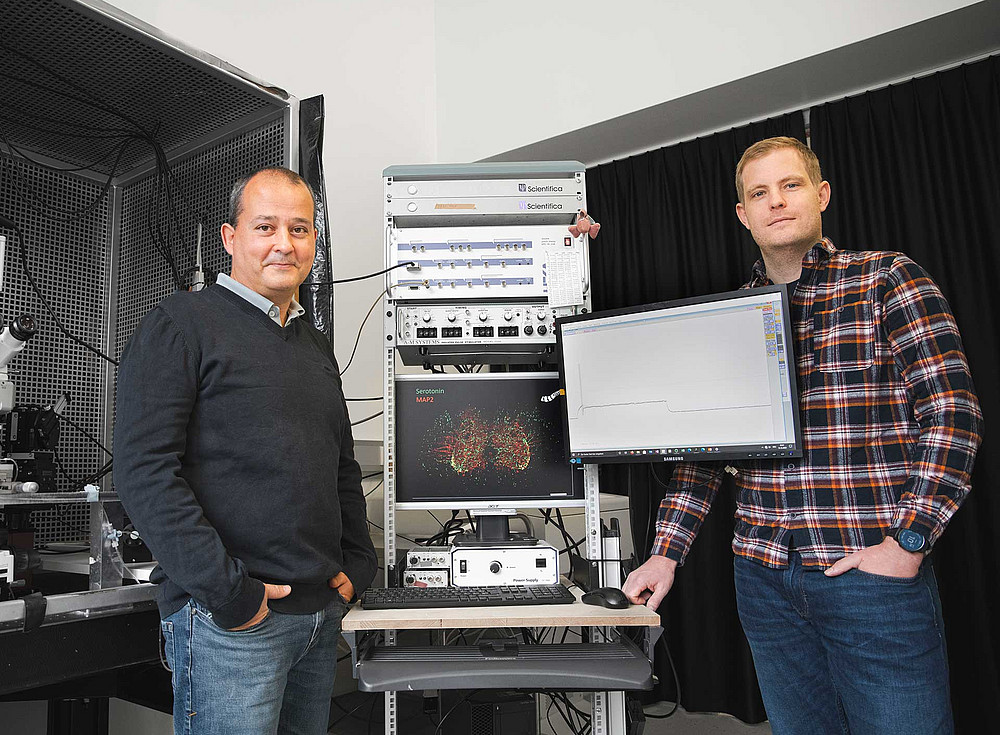
Boris Chagnaud (left) and Maximilian Bothe ©Uni Graz/Tzivanopoulos

Boris Chagnaud (left) and Maximilian Bothe have investigated the network of nerves in the spinal cord of rattlesnakes. Photo: Uni Graz/Tzivanopoulos

Cheetahs, sloths, snakes: they all move at vastly different speeds but the network of nerves in their spinal cords responsible for their movement is structurally quite similar. Led by the University of Graz, an international team of researchers has now figured out evolution’s trick for speeding up vertebrates. It turns out that specific proteins significantly influence the rapid processing of motor commands.

Researchers were able to unravel the mystery with the help of the rattlesnake. “A rattlesnake slides forward quite slowly yet is also capable of very fast movements with its famous rattle at the end of its tail”, explain Maximilian Bothe and Boris Chagnaud from the Department of Biology at the University of Graz. The two have discovered that certain physiological differences in nerve cells can have a decisive influence on muscle control. This makes it possible to manage precisely how and when a muscle contracts. The so-called KV7 ion channels play a vital role in this regard. These channels are special proteins contained in the motor neurons of the spinal cord – the interface between the brain and the body – and determine the timing of motor activity. “They are also important for the precision of movement”, emphasizes Maximilian Bothe.

The neurobiologists have also succeeded in increasing the influence of these proteins and thus reversing movement properties from slow to fast. But the researchers are quick to stress that adding these proteins will not turn anyone into a sprinter ‒ not slow vertebrates and certainly not us humans. “The processing of movement sequences is a complex interaction of many different factors”, explains Bothe. The findings could, however, provide further insights into how new forms of movement can emerge in the animal kingdom in the course of evolution.

Video clip


Maximilian Bothe and Boris Chagnaud published the results of their joint research with biologists from the Technical University of Munich and LMU Munich, the University of Veterinary Medicine Hannover and Michigan State University in Current Biology, a specialist journal published by Cell Press – Current Biology.

created by Andreas Schweiger

Related news

COLIBRI Visiting Fellow Dr. Ziggy O'Reilly

What vision reveals about the seat of consciousness

Researchers at the University of Graz are using vision experiments to investigate how our brain constructs reality. The results offer insights into individual perception, are a piece of the puzzle in the search for the “consciousness” and offer new approaches to understanding neurodiversity.

True crime: psychologist identifies reasons for the fascination of the genre

True crime documentaries, series and podcasts about real crimes have many fans. What is it that makes this genre so fascinating? Is it the insights into the dark side of the human psyche or into meticulous investigations? Or is it that dealing with crime trains our ability to cope with fear? These and other questions are being asked by psychologist Corinna Perchtold-Stefan in a research project. The first results are already available.

Bienendoku

Kurzer Abstract/optional

Begin of page section:
Additional information:

University of Graz
Universitaetsplatz 3
8010 Graz
Austria
  • Contact
  • Web Editors
  • Moodle
  • UNIGRAZonline
  • Imprint
  • Data Protection Declaration
  • Accessibility Declaration
Weatherstation
Uni Graz

End of this page section. Go to overview of page sections

End of this page section. Go to overview of page sections

Begin of page section:

End of this page section. Go to overview of page sections