Begin of page section:
Page sections:

  • Go to contents (Accesskey 1)
  • Go to position marker (Accesskey 2)
  • Go to main navigation (Accesskey 3)
  • Go to sub navigation (Accesskey 4)
  • Go to additional information (Accesskey 5)
  • Go to page settings (user/language) (Accesskey 8)
  • Go to search (Accesskey 9)

End of this page section. Go to overview of page sections

Begin of page section:
Page settings:

English en
Deutsch de
Search
Login

End of this page section. Go to overview of page sections

Begin of page section:
Search:

Search for details about Uni Graz
Close

End of this page section. Go to overview of page sections


Search

Begin of page section:
Main navigation:

Page navigation:

  • University

    University
    • About the University
    • Organisation
    • Faculties
    • Library
    • Working at University of Graz
    • Campus
    Developing solutions for the world of tomorrow - that is our mission. Our students and our researchers take on the great challenges of society and carry the knowledge out.
  • Research Profile

    Research Profile
    • Our Expertise
    • Research Questions
    • Research Portal
    • Promoting Research
    • Research Transfer
    • Ethics in Research
    Scientific excellence and the courage to break new ground. Research at the University of Graz creates the foundations for making the future worth living.
  • Studies

    Studies
    • Prospective Students
    • Students
    • Welcome Weeks for First Year Students
  • Community

    Community
    • International
    • Location
    • Research and Business
    • Alumni
    The University of Graz is a hub for international research and brings together scientists and business experts. Moreover, it fosters the exchange and cooperation in study and teaching.
  • Spotlight
Topics
  • Sustainable University
  • Researchers answer
  • Work for us
Close menu

End of this page section. Go to overview of page sections

Begin of page section:
You are here:

University of Graz COLIBRI News Talk "Symbiotic designs - how to live together"
  • COLIBRI Day 2026
  • Doctoral Consortium Complexity of Life
  • Members
  • Contact
  • News
  • Events

End of this page section. Go to overview of page sections

Tuesday, 10 December 2019

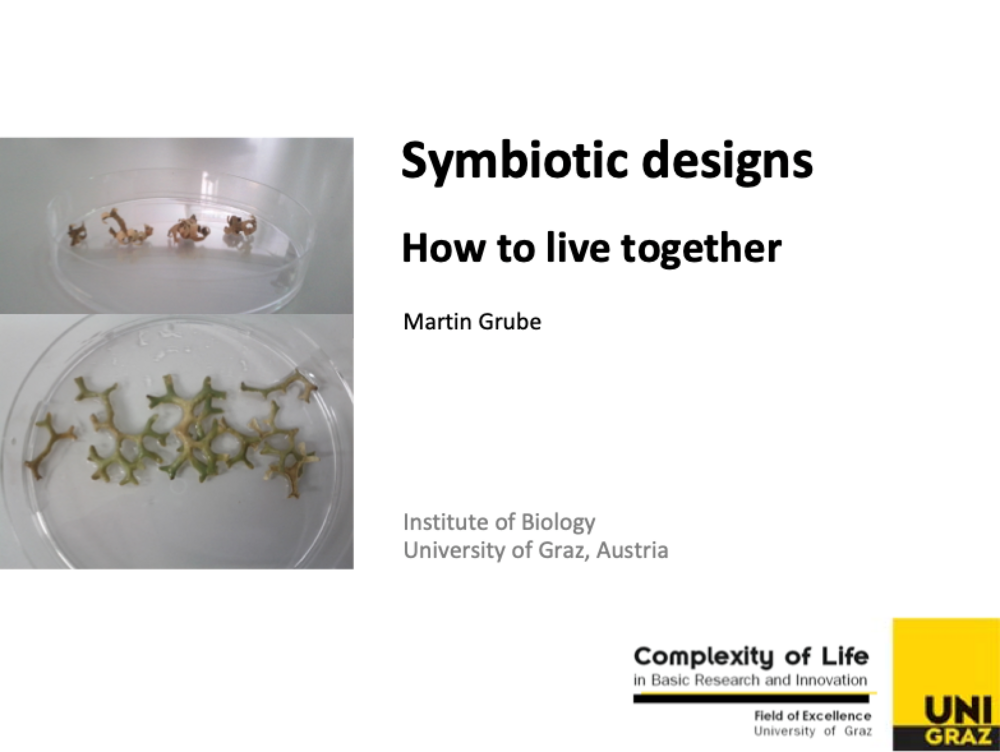
Talk "Symbiotic designs - how to live together"

Talk given by Prof. Martin Grube, 10.12.2019, 18:00 CET, in the course of the "Kolleg Erde 3.0" at the Uni Greifswald, Germany.

https://www.wiko-greifswald.de/programm/vortraege/aktuelle-schwerpunkte/planet-erde-30/

Planet Erde 3.0

Alle Veranstaltungen im Kolleg auf einen Blick

Die Vortragsreihe des Alfried Krupp Wissenschaftskollegs Greifswald und der Universität Greifswald wird gefördert von der Alfried Krupp von Bohlen und Halbach-Stiftung, Essen, und der Deutschen Forschungsgemeinschaft, Bonn. Das Alfried Krupp Wissenschaftskolleg Greifswald ist eine wissenschaftlich unabhängige Einrichtung in der Trägerschaft der Stiftung Alfried Krupp Kolleg Greifswald.

Veranstaltungsorte:
Universität Greifswald
(Hörsaal 5, Rubenowstraße 1, 17489 Greifswald)
Alfried Krupp Wissenschaftskolleg Greifswald
(Martin-Luther-Straße 14, 17489 Greifswald)

THEMEN UND TERMINE:

15. Oktober 2019· 18.00 Uhr · Universität Greifswald
How do we make sense of thermal biology in a variable world?
Asst. Prof. Dr. Katie Marshall (University of British Columbia)

22. Oktober 2019 · 18.00 Uhr · Alfried Krupp Kolleg
Saisonale Anpassung: Von der organismischen bis zur zellulären Ebene
Professor Dr. Walter Arnold (Universität Wien)

29. Oktober 2019 · 18.00 Uhr · Universität Greifswald
Tree phenology in a warmer world
Dr. Andrey Malyshev (Universität Greifswald)

5. November 2019 · 18.00 Uhr · Universität Greifswald
Exploring butterfly eyespots and the concept of developmental bias in evolution
Professor Paul Brakefied (University of Cambridge)

12. November 2019 · 18.00 Uhr · Universität Greifswald
The evolutionary ecology of forest trees - on track of gene flow and local Adaptation
Dr. Katrin Heer (Philipps-Universität Marburg)

19. November 2019 · 18.00 Uhr · Alfried Krupp Kolleg
Konstruktiver Holzbau im Zeitalter des Digitalen
Hans-Jakob Wagner (Universität Stuttgart)

26. November 2019 · 18.00 Uhr · Universität Greifswald
Microclimate modulates the responses of ecotherms to climate change: a good or a bad thing?
Dr. Sylvain Pincebourde (Institut de Recherce sur la Biologie de l'Insecte, Tours)

3. Dezember 2019 · 18.00 Uhr · Alfried Krupp Kolleg
Walwanderungen - wandern Wale heute anders als vor 100 Jahren?
Dr. Michael Dähne (Deutsches Meeresmuseum, Stralsund)

10. Dezember 2019 · 18.00 Uhr · Universität Greifswald
Symbiotic designs - how to live together
Professor Dr. Martin Grube (Universität Graz)

17. Dezember 2019 · 18.00 Uhr · Universität Greifswald
Enzymatic degradation of plastics: Is this a solution for the planet?
Professor Dr. Uwe Bornscheuer (Universität Greifswald)

7. Januar 2020 · 18.00 Uhr · Universität Greifswald
The Gulfstream circulation: mean, variability and trends
Professor Dr. Monika Rhein (Universität Bremen)

14. Januar 2020 · 18.00 Uhr · Universität Greifswald
Plant Microbe Ecology in Peatlands
Dr. Bjorn Robroek (Radboud University Nijmegen)

21. Januar 2020 · 18.00 Uhr · Alfried Krupp Kolleg
Das globale Assessment zu Biodiversität und Ökosystemleistungen des Weltbiodiversitätsrates IPBES - Kernaussagen und Hintergründe
Professor Josef Settele (Helmholtz Centre for Environmental Research - UFZ)

28. Januar 2020 · 18.00 Uhr · Universität Greifswald
Towards improved biodiversity forecasts
Dr. Damaris Zurell (Humboldt-Universität zu Berlin)

Related news

COLIBRI Visiting Fellow Dr. Ziggy O'Reilly

What vision reveals about the seat of consciousness

Researchers at the University of Graz are using vision experiments to investigate how our brain constructs reality. The results offer insights into individual perception, are a piece of the puzzle in the search for the “consciousness” and offer new approaches to understanding neurodiversity.

True crime: psychologist identifies reasons for the fascination of the genre

True crime documentaries, series and podcasts about real crimes have many fans. What is it that makes this genre so fascinating? Is it the insights into the dark side of the human psyche or into meticulous investigations? Or is it that dealing with crime trains our ability to cope with fear? These and other questions are being asked by psychologist Corinna Perchtold-Stefan in a research project. The first results are already available.

Bienendoku

Kurzer Abstract/optional

Begin of page section:
Additional information:

University of Graz
Universitaetsplatz 3
8010 Graz
Austria
  • Contact
  • Web Editors
  • Moodle
  • UNIGRAZonline
  • Imprint
  • Data Protection Declaration
  • Accessibility Declaration
Weatherstation
Uni Graz

End of this page section. Go to overview of page sections

End of this page section. Go to overview of page sections

Begin of page section:

End of this page section. Go to overview of page sections