Begin of page section:
Page sections:

  • Go to contents (Accesskey 1)
  • Go to position marker (Accesskey 2)
  • Go to main navigation (Accesskey 3)
  • Go to sub navigation (Accesskey 4)
  • Go to additional information (Accesskey 5)
  • Go to page settings (user/language) (Accesskey 8)
  • Go to search (Accesskey 9)

End of this page section. Go to overview of page sections

Begin of page section:
Page settings:

English en
Deutsch de
Search
Login

End of this page section. Go to overview of page sections

Begin of page section:
Search:

Search for details about Uni Graz
Close

End of this page section. Go to overview of page sections


Search

Begin of page section:
Main navigation:

Page navigation:

  • University

    University
    • About the University
    • Organisation
    • Faculties
    • Library
    • Working at University of Graz
    • Campus
    Developing solutions for the world of tomorrow - that is our mission. Our students and our researchers take on the great challenges of society and carry the knowledge out.
  • Research Profile

    Research Profile
    • Our Expertise
    • Research Questions
    • Research Portal
    • Promoting Research
    • Research Transfer
    • Ethics in Research
    Scientific excellence and the courage to break new ground. Research at the University of Graz creates the foundations for making the future worth living.
  • Studies

    Studies
    • Prospective Students
    • Students
    • Welcome Weeks for First Year Students
  • Community

    Community
    • International
    • Location
    • Research and Business
    • Alumni
    The University of Graz is a hub for international research and brings together scientists and business experts. Moreover, it fosters the exchange and cooperation in study and teaching.
  • Spotlight
Topics
  • Sustainable University
  • Researchers answer
  • Work for us
Close menu

End of this page section. Go to overview of page sections

Begin of page section:
You are here:

University of Graz COLIBRI News Snake Alarm
  • COLIBRI Day 2026
  • Doctoral Consortium Complexity of Life
  • Members
  • Contact
  • News
  • Events

End of this page section. Go to overview of page sections

Monday, 23 August 2021

Snake Alarm

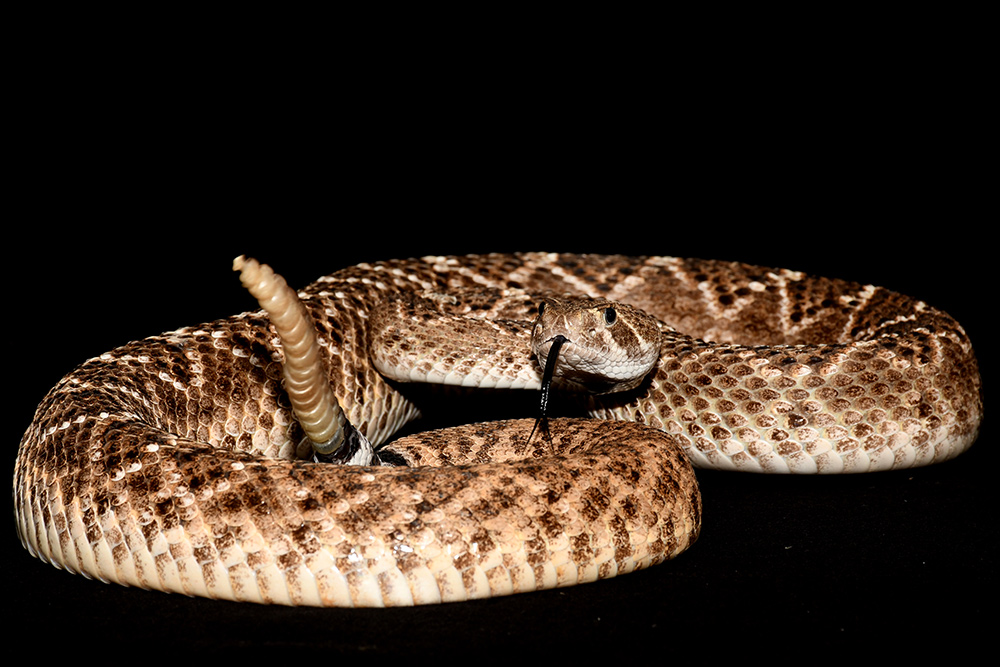
The warning signal of rattlesnakes has been deciphered by biologists at the University of Graz. Photo: Uni Graz

The warning signal of rattlesnakes has been deciphered by biologists at the University of Graz. Photo: Uni Graz

Researchers at the University of Graz decipher rattling signals

This summer escaped colubrids and vipers that suddenly bit people in supposedly safe places made headlines. Unlike their nasty kin, rattlesnakes give advance signals in order to warn anybody of their presence, using a sophisticated noise pattern. As biologists of the University of Graz found out, their signals contain more information than previously assumed: the closer a potential enemy – e.g. a large mammal – approaches to the reptile, the faster the latter’s rattling becomes. When a distance becomes threateningly short, the snake changes its strategy, starting to rattle at a high frequency. “A good trick, which makes approaching animals underestimate the distance”, Boris Chagnaud, member of the Institute of Biology, discovered together with colleagues of the TU und der LMU Munich. The findings were recently published in the journal „Current Biology“.

Warning signal of a rattlesnake

“Snakes’ rattling evolved in parallel to noise perception by large mammals, that could have walked on the well-camouflaged reptiles, killing them or at least urging them to a venomous bite,” explains the researcher. His studies, in which he confronted test persons with various warning noise-pattern signals in a virtual-reality environment, confirmed this hypothesis. “Snakes speeding up to unexpected HF rattling would usually make test persons underestimate distance from the snake,” adds Chagnaud. Whether these animals’ strategy will still be successful in the future, is uncertain. “A growing number of observations show that some rattlesnakes have started to avoid rattling in order to prevent localization and killing,” says the biologist.

created by Dagmar Eklaude

Related news

COLIBRI Visiting Fellow Dr. Ziggy O'Reilly

What vision reveals about the seat of consciousness

Researchers at the University of Graz are using vision experiments to investigate how our brain constructs reality. The results offer insights into individual perception, are a piece of the puzzle in the search for the “consciousness” and offer new approaches to understanding neurodiversity.

True crime: psychologist identifies reasons for the fascination of the genre

True crime documentaries, series and podcasts about real crimes have many fans. What is it that makes this genre so fascinating? Is it the insights into the dark side of the human psyche or into meticulous investigations? Or is it that dealing with crime trains our ability to cope with fear? These and other questions are being asked by psychologist Corinna Perchtold-Stefan in a research project. The first results are already available.

Bienendoku

Kurzer Abstract/optional

Begin of page section:
Additional information:

University of Graz
Universitaetsplatz 3
8010 Graz
Austria
  • Contact
  • Web Editors
  • Moodle
  • UNIGRAZonline
  • Imprint
  • Data Protection Declaration
  • Accessibility Declaration
Weatherstation
Uni Graz

End of this page section. Go to overview of page sections

End of this page section. Go to overview of page sections

Begin of page section:

End of this page section. Go to overview of page sections