Begin of page section:
Page sections:

  • Go to contents (Accesskey 1)
  • Go to position marker (Accesskey 2)
  • Go to main navigation (Accesskey 3)
  • Go to sub navigation (Accesskey 4)
  • Go to additional information (Accesskey 5)
  • Go to page settings (user/language) (Accesskey 8)
  • Go to search (Accesskey 9)

End of this page section. Go to overview of page sections

Begin of page section:
Page settings:

English en
Deutsch de
Search
Login

End of this page section. Go to overview of page sections

Begin of page section:
Search:

Search for details about Uni Graz
Close

End of this page section. Go to overview of page sections


Search

Begin of page section:
Main navigation:

Page navigation:

  • University

    University
    • About the University
    • Organisation
    • Faculties
    • Library
    • Working at University of Graz
    • Campus
    Developing solutions for the world of tomorrow - that is our mission. Our students and our researchers take on the great challenges of society and carry the knowledge out.
  • Research Profile

    Research Profile
    • Our Expertise
    • Research Questions
    • Research Portal
    • Promoting Research
    • Research Transfer
    • Ethics in Research
    Scientific excellence and the courage to break new ground. Research at the University of Graz creates the foundations for making the future worth living.
  • Studies

    Studies
    • Prospective Students
    • Students
    • Welcome Weeks for First Year Students
  • Community

    Community
    • International
    • Location
    • Research and Business
    • Alumni
    The University of Graz is a hub for international research and brings together scientists and business experts. Moreover, it fosters the exchange and cooperation in study and teaching.
  • Spotlight
Topics
  • Sustainable University
  • Researchers answer
  • Work for us
Close menu

End of this page section. Go to overview of page sections

Begin of page section:
You are here:

University of Graz COLIBRI News 1,2 Millionen Euro FWF-Förderung für Sprachwandel-Projekt
  • COLIBRI Day 2026
  • Doctoral Consortium Complexity of Life
  • Members
  • Contact
  • News
  • Events

End of this page section. Go to overview of page sections

Friday, 21 June 2024

1.2 million euros FWF funding for language change project

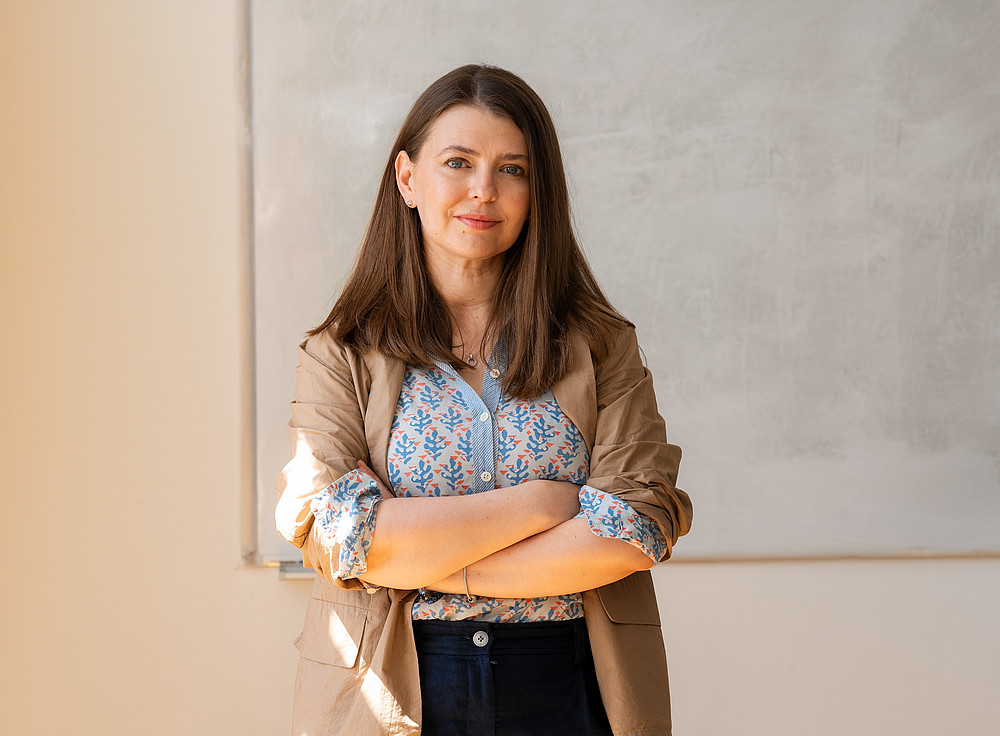
A woman stands in front of a wall

Ukrainian-born Svitlana Antonyuk is a researcher at the University of Graz. She analyses linguistic processes using innovative methods. Photo: FWF/Sabine Hoffmann

The generative linguist Svitlana Antonyuk is researching the emotional factors of language change.

When people speak, express themselves verbally and articulate, it is not without emotion. As in every system, there are certain patterns that we consciously or unconsciously follow in the act of speaking. At the University of Graz, a generative linguist, Svitlana Antonyuk, is researching the emotional factors of language change. She is combining sociolinguistic and neurolinguistic methods to investigate the psychological mechanisms that influence language use and change. The project is being funded with 1.2 million euros as part of the FWF Start Award. Antonyuk is a Lise Meitner Senior Postdoctoral Researcher.
 

“We hope to understand the mechanisms by which human emotions play a role in language contact and language change situations,” explains Antonyuk. “Predicting language change has so far been an extremely difficult, if not insurmountable, challenge in linguistics.” The linguist now wants to find out more about this. The starting point of the research is the hypothesis that conscious and unconscious emotional attitudes towards linguistic material can put the language system under pressure and thus trigger predictable language change. This innovative approach promises to provide significant insights into the role of emotional factors in linguistic processes.
 

One particularly interesting aspect here, for example, is the linguistic reactions of Ukrainians to Russia's unprovoked aggression. “On the day of the invasion, thousands of Russian-speaking Ukrainians decided to switch to Ukrainian as their primary language of communication to express their identity and resistance,” reports Antonyuk. This unique sociolinguistic situation offers researchers a rare opportunity to study the role of emotions and speaker decisions in language change in real time. The results of this research project promise to make significant contributions to the understanding of language change and to shed light on the importance of emotional factors in linguistic processes. Normally, language change is visible over centuries, but in the case of Ukrainian, the measurement will take place almost in real time.
 

“I would like to congratulate Svitlana Antonyuk on this award. Her research on language change in Ukrainian is of great social and highly topical relevance. This significant funding from the FWF in the amount of 1.2 million euros underlines once again how important it is to support young researchers in their work and to give them the opportunity to advance forward-looking projects. The University of Graz is consistently committed to promoting excellent talent and is thus making a significant contribution to the future of science,” emphasizes Rector Peter Riedler.
 

FWF funds project and summer school
In the first phase, a team of experts consisting of linguists and neuroscientists will carry out an empirical study and a generative-theoretical analysis of Ukrainian syntax (structural representation of grammar) and morphosyntax, followed by a sociolinguistic and neurolinguistic investigation of linguistic stimuli identified with the help of generative linguistic typological analysis. The FWF START Award not only supports the realization of this research, but also the establishment of a biennial summer school on Ukrainian linguistics at the University of Graz. This will bring together language experts with different theoretical perspectives and promote new collaborations. “The aim is to understand the complexity of the human mind through the study of language,” emphasizes Antonyuk.

created by Konstantin Tzivanopoulos

Related news

COLIBRI Visiting Fellow Dr. Ziggy O'Reilly

What vision reveals about the seat of consciousness

Researchers at the University of Graz are using vision experiments to investigate how our brain constructs reality. The results offer insights into individual perception, are a piece of the puzzle in the search for the “consciousness” and offer new approaches to understanding neurodiversity.

True crime: psychologist identifies reasons for the fascination of the genre

True crime documentaries, series and podcasts about real crimes have many fans. What is it that makes this genre so fascinating? Is it the insights into the dark side of the human psyche or into meticulous investigations? Or is it that dealing with crime trains our ability to cope with fear? These and other questions are being asked by psychologist Corinna Perchtold-Stefan in a research project. The first results are already available.

Bienendoku

Kurzer Abstract/optional

Begin of page section:
Additional information:

University of Graz
Universitaetsplatz 3
8010 Graz
Austria
  • Contact
  • Web Editors
  • Moodle
  • UNIGRAZonline
  • Imprint
  • Data Protection Declaration
  • Accessibility Declaration
Weatherstation
Uni Graz

End of this page section. Go to overview of page sections

End of this page section. Go to overview of page sections

Begin of page section:

End of this page section. Go to overview of page sections