Begin of page section:
Page sections:

  • Go to contents (Accesskey 1)
  • Go to position marker (Accesskey 2)
  • Go to main navigation (Accesskey 3)
  • Go to sub navigation (Accesskey 4)
  • Go to additional information (Accesskey 5)
  • Go to page settings (user/language) (Accesskey 8)
  • Go to search (Accesskey 9)

End of this page section. Go to overview of page sections

Begin of page section:
Page settings:

English en
Deutsch de
Search
Login

End of this page section. Go to overview of page sections

Begin of page section:
Search:

Search for details about Uni Graz
Close

End of this page section. Go to overview of page sections


Search

Begin of page section:
Main navigation:

Page navigation:

  • University

    University
    • About the University
    • Organisation
    • Faculties
    • Library
    • Working at University of Graz
    • Campus
    Developing solutions for the world of tomorrow - that is our mission. Our students and our researchers take on the great challenges of society and carry the knowledge out.
  • Research Profile

    Research Profile
    • Our Expertise
    • Research Questions
    • Research Portal
    • Promoting Research
    • Research Transfer
    • Ethics in Research
    Scientific excellence and the courage to break new ground. Research at the University of Graz creates the foundations for making the future worth living.
  • Studies

    Studies
    • Prospective Students
    • Students
    • Welcome Weeks for First Year Students
  • Community

    Community
    • International
    • Location
    • Research and Business
    • Alumni
    The University of Graz is a hub for international research and brings together scientists and business experts. Moreover, it fosters the exchange and cooperation in study and teaching.
  • Spotlight
Topics
  • Sustainable University
  • Researchers answer
  • Work for us
Close menu

End of this page section. Go to overview of page sections

Begin of page section:
You are here:

University of Graz COLIBRI News Wassermusik
  • COLIBRI Day 2026
  • Doctoral Consortium Complexity of Life
  • Members
  • Contact
  • News
  • Events

End of this page section. Go to overview of page sections

Thursday, 20 May 2021

Wassermusik

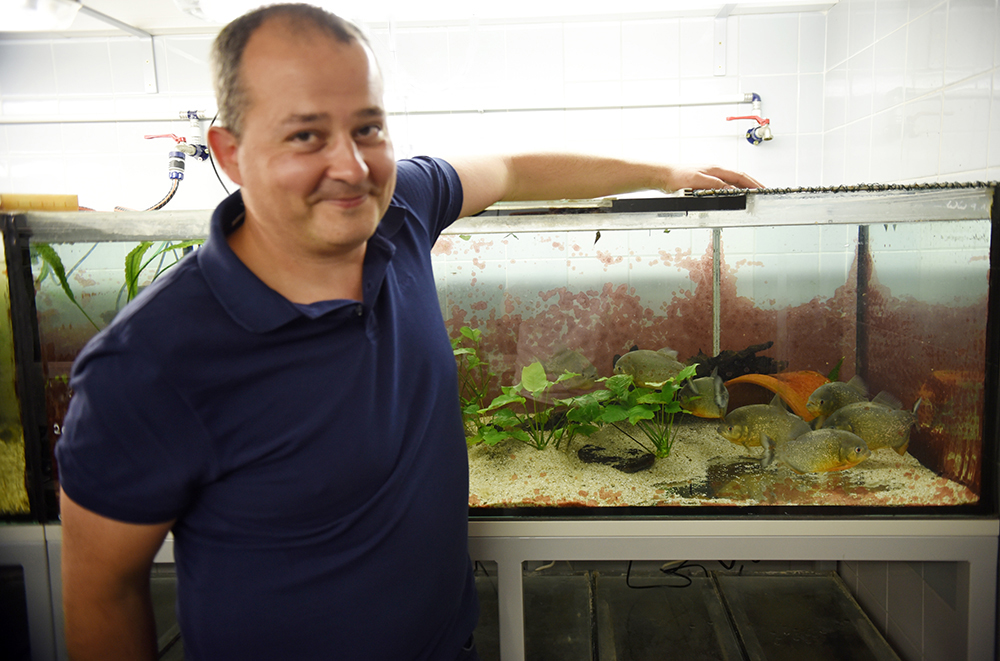
Neurobiologe Boris Chagnaud forscht mit kommunikativen Piranhas. Foto: Uni Graz/Schweiger

Neurobiologe Boris Chagnaud forscht mit kommunikativen Piranhas. Foto: Uni Graz/Schweiger

Der Sound der Piranhas: ZoologInnen der Uni Graz klären, wie sich Kommunikation der Fische entwickelte

Piranhas sind weder stumme Fische noch mörderische Bestien, sondern ganz schön kommunikativ. Wie es dazu überhaupt kam, konnten ZoologInnen der Universität Graz zusammen mit WissenschafterInnen der belgischen Universität Liège nun klären. Zur akustischen Verständigung hat sich im Laufe der Evolution bei den Tieren ein eigenes neuronales Netzwerk entwickelt, das Muskeln auf ihre Schwimmblase „trommeln“ lässt.

Stumm? Von wegen. Viele Fische produzieren Laute, um ihr Revier zu verteidigen und SexualpartnerInnen zu gewinnen. So auch die Piranhas, die sich vorrangig in südamerikanischen Gewässern tummeln – und keineswegs so gefährlich sind, wie in Horrorfilmen dargestellt, betont Neurobiologe Boris Chagnaud. Weitere Aufklärungsarbeit leistete er kürzlich in einem an den Universitäten Graz und Liège angesiedelten Forschungsprojekt.

„Piranhas erzeugen Töne durch die Vibration ihrer Schwimmblase, ausgelöst von der Kontraktion zweier Muskeln, die ursprünglich für das Schwimmen eingesetzt wurden“, erläutert Chagnaud, Professor am Institut für Biologie der Uni Graz. Das Besondere dabei, wie die WissenschafterInnen mit Hilfe von Muskelaktivitätsmessungen feststellen konnten: Neuronale Netzwerke für langsame, wechselweise durchgeführte Muskel-Kontraktion, die für die Fortbewegung notwendig sind, veränderten sich allmählich zu Netzwerken für eine sehr schnelle, gleichzeitige Anspannung von Muskeln. Diese Veränderung im Aktivitätsmuster der Muskel erlaubt den Piranhas komplexe akustische Signale hervorzubringen.
Boris Chagnaud begründet: „Wir konnten zeigen, dass sich im Laufe der Evolution aus dem zentralen Nervensystem im Rückenmark eine eigene motorische Kontrolle herausgebildet hat, die für die Fähigkeit der Lauterzeugung verantwortlich ist.“

>> So hören sich Piranhas an

>> Publikation


created by Andreas Schweiger

Related news

COLIBRI Visiting Fellow Dr. Ziggy O'Reilly

What vision reveals about the seat of consciousness

Researchers at the University of Graz are using vision experiments to investigate how our brain constructs reality. The results offer insights into individual perception, are a piece of the puzzle in the search for the “consciousness” and offer new approaches to understanding neurodiversity.

True crime: psychologist identifies reasons for the fascination of the genre

True crime documentaries, series and podcasts about real crimes have many fans. What is it that makes this genre so fascinating? Is it the insights into the dark side of the human psyche or into meticulous investigations? Or is it that dealing with crime trains our ability to cope with fear? These and other questions are being asked by psychologist Corinna Perchtold-Stefan in a research project. The first results are already available.

Bienendoku

Kurzer Abstract/optional

Begin of page section:
Additional information:

University of Graz
Universitaetsplatz 3
8010 Graz
Austria
  • Contact
  • Web Editors
  • Moodle
  • UNIGRAZonline
  • Imprint
  • Data Protection Declaration
  • Accessibility Declaration
Weatherstation
Uni Graz

End of this page section. Go to overview of page sections

End of this page section. Go to overview of page sections

Begin of page section:

End of this page section. Go to overview of page sections