Begin of page section:
Page sections:

  • Go to contents (Accesskey 1)
  • Go to position marker (Accesskey 2)
  • Go to main navigation (Accesskey 3)
  • Go to sub navigation (Accesskey 4)
  • Go to additional information (Accesskey 5)
  • Go to page settings (user/language) (Accesskey 8)
  • Go to search (Accesskey 9)

End of this page section. Go to overview of page sections

Begin of page section:
Page settings:

English en
Deutsch de
Search
Login

End of this page section. Go to overview of page sections

Begin of page section:
Search:

Search for details about Uni Graz
Close

End of this page section. Go to overview of page sections


Search

Begin of page section:
Main navigation:

Page navigation:

  • University

    University
    • About the University
    • Organisation
    • Faculties
    • Library
    • Working at University of Graz
    • Campus
    Developing solutions for the world of tomorrow - that is our mission. Our students and our researchers take on the great challenges of society and carry the knowledge out.
  • Research Profile

    Research Profile
    • Our Expertise
    • Research Questions
    • Research Portal
    • Promoting Research
    • Research Transfer
    • Ethics in Research
    Scientific excellence and the courage to break new ground. Research at the University of Graz creates the foundations for making the future worth living.
  • Studies

    Studies
    • Prospective Students
    • Students
    • Welcome Weeks for First Year Students
  • Community

    Community
    • International
    • Location
    • Research and Business
    • Alumni
    The University of Graz is a hub for international research and brings together scientists and business experts. Moreover, it fosters the exchange and cooperation in study and teaching.
  • Spotlight
Topics
  • Sustainable University
  • Researchers answer
  • Work for us
Close menu

End of this page section. Go to overview of page sections

Begin of page section:
You are here:

University of Graz COLIBRI News Forscher:innen klären auf, warum Steroidhormone die Entstehung von Darmkrebs beeinflussen
  • COLIBRI Day 2026
  • Doctoral Consortium Complexity of Life
  • Members
  • Contact
  • News
  • Events

End of this page section. Go to overview of page sections

Monday, 03 February 2025

Forscher:innen klären auf, warum Steroidhormone die Entstehung von Darmkrebs beeinflussen

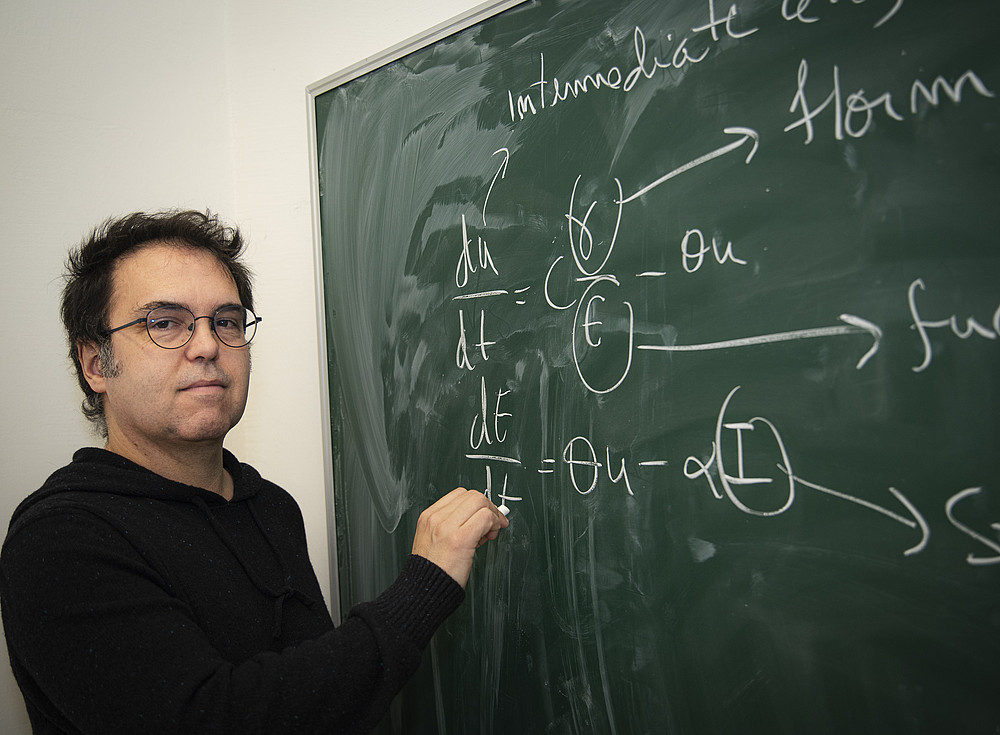
Komplexitätsforscher Bernat Corominas-Murtra hat ein mathematisches Modell eines Tumors erarbeitet, das neue Einblicke in die Rolle von Steroidhormonen auf das Darmkrebswachstum ermöglicht. Foto: Uni Graz/Tzivanopoulos. ©Uni Graz/Tzivanopoulos

Komplexitätsforscher Bernat Corominas-Murtra hat ein mathematisches Modell eines Tumors erarbeitet, das neue Einblicke in die Rolle von Steroidhormonen auf das Darmkrebswachstum ermöglicht. Foto: Uni Graz/Tzivanopoulos.

Darmkrebs ist eine der häufigsten Krebserkrankungen. Auffällig sind dabei geschlechtsabhängige Unterschiede. „Frauen haben ein geringeres Risiko zu erkranken – und zwar unabhängig von anderen Risikofaktoren wie Rauchen oder Alkoholkonsum. Das deutet darauf hin, dass weibliche Steroidhormone, wie etwa Östrogene, eine schützende Funktion haben“, erklärt Komplexitätsforscher Bernat Corominas-Murtra vom Institut für Biologie der Universität Graz und Professor des Profilbereich “Complexity in Life, Basic Research and Innovation”.

Er hat gemeinsam mit Kolleg:innen Lisa Zipper and Tobias Reiff von der Heinrich Heine Universität Düsseldorf Steroidhormone – dazu gehören zum Beispiel Testosteron, Östrogen oder Cortisol – innerhalb gutartiger Tumore in einem Fruchtfliegen-Modell untersucht. Die Wissenschaftler:innen haben gezeigt, dass ein dem Östrogen sehr ähnliches Steroidhormon namens „Ecdyson“ eine tumorunterdrückende Rolle hat. Die Ergebnisse wurden im Fachjournal Nature Communications veröffentlicht. 

„Fruchtfliegen-Modelle können für solche Studien sehr erfolgreich eingesetzt werden, weil ihr Darmepithel dem menschlichen in Struktur und Funktion sehr ähnlich ist“, schildert Stammzellenbiologe Tobias Reiff. Das Darmepithel ist eine spezielle Zellschicht, die das Innere von Dünn- und Dickdarm auskleidet, Nährstoffe und Wasser aus der Nahrung aufnimmt und Schädliches draußen hält. Auch die molekulare Signalwege der Steroidhormone wirken in den Fruchtfliegen in gleicher Weise wie beim Menschen. 

Mithilfe von neuen Tumormodellen haben die Forscher:innen ein Protein identifiziert, das gegensätzliche Wirkungen haben kann, je nachdem ob es innerhalb oder außerhalb des Tumors auftritt. Bernat Corominas-Murtra: „Wenn wir das Protein innerhalb des Tumors aktivieren, unterdrückt es die Entstehung von Darmkrebs. Befindet es außerhalb des Tumors, fördert es dessen Wachstum.“ Diese Ergebnisse tragen entscheidend zum Verständnis vermeintlich gegensätzlicher Rollen von Steroidhormonen auf das Darmkrebswachstum bei. Und sie können die Entwicklung und Optimierung von Therapiemethoden anregen.


Publikation: Zipper L, Corominas-Murtra B, Reiff T. Steroid hormone-induced wingless ligands tune female intestinal size in Drosophila. Nat Commun 16(1): 436. Published 2025 Jan 6. doi: 10.1038/s41467-024-55664-2. >> Zur Online Version 

created by Gerhild Leljak

Related news

COLIBRI Visiting Fellow Dr. Ziggy O'Reilly

What vision reveals about the seat of consciousness

Researchers at the University of Graz are using vision experiments to investigate how our brain constructs reality. The results offer insights into individual perception, are a piece of the puzzle in the search for the “consciousness” and offer new approaches to understanding neurodiversity.

True crime: psychologist identifies reasons for the fascination of the genre

True crime documentaries, series and podcasts about real crimes have many fans. What is it that makes this genre so fascinating? Is it the insights into the dark side of the human psyche or into meticulous investigations? Or is it that dealing with crime trains our ability to cope with fear? These and other questions are being asked by psychologist Corinna Perchtold-Stefan in a research project. The first results are already available.

Bienendoku

Kurzer Abstract/optional

Begin of page section:
Additional information:

University of Graz
Universitaetsplatz 3
8010 Graz
Austria
  • Contact
  • Web Editors
  • Moodle
  • UNIGRAZonline
  • Imprint
  • Data Protection Declaration
  • Accessibility Declaration
Weatherstation
Uni Graz

End of this page section. Go to overview of page sections

End of this page section. Go to overview of page sections

Begin of page section:

End of this page section. Go to overview of page sections